
Using Visuals to Support Language Development: Making Communication More Accessible
Language is all around us, like in conversations, routines, play, mealtimes, shopping trips, and daily life. But spoken language moves quickly. Words are said and then they’re gone!
For some children, spoken language is easy to process. For others, it can feel overwhelming or difficult to hold onto. This is where visual supports can help!
Visuals are tools that can make language more accessible, support understanding, reduce cognitive load, and give children another way to engage, communicate, and participate in their everyday world.
For many children, including autistic children, children with language delays, and children who simply benefit from seeing information as well as hearing it, visuals can provide an extra layer of support that makes communication clearer and more meaningful.
Visuals: Supporting Communication for Everyone
When paired with spoken language, visuals provide a concrete example of the language or vocabulary.
This means children have more time to:
Process information
Understand expectations and routines
Make choices
Learn new vocabulary
Express ideas and preferences
Participate in everyday activities in a way that feels safe and comfortable to them
Visual supports can reduce the pressure of having to process language in real time and can offer another pathway for communication.
Importantly, visuals are not a replacement for speech, and they are not only for children who “aren’t talking.” Visual supports can benefit many different communicators because they support understanding, expression, and participation.
Visuals can take many forms, including:
Visual schedules
Aided Language Displays (ALDs)
Choice boards
Picture-based routines
Visual reminders
Written checklists
Photos, symbols, or simple drawings
What matters is not what the visual looks like, it’s that it helps make communication, routines, and expectations easier to understand and participate in.
How We Use Visuals at Small Sprouts Therapy
At Small Sprouts Therapy, you won’t be able to step into our waiting room, resource room, or therapy rooms without seeing visuals!
We use visuals in many different ways to support communication access and participation across therapy sessions.
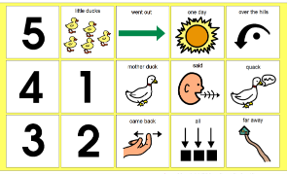
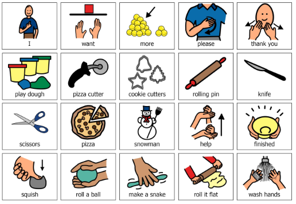
One of the ways we do this is through Aided Language Displays (ALDs) with different vocabulary, matched to the activity or theme. For example, we might use a visual board during a playdough activity with words like roll, cut, squish, open, more, help, and finished, or during nursery rhymes, using Song Boards with vocabulary that supports singing, requesting, commenting, and joining in.
These boards support both understanding and expression and allow us to use aided language modelling - pointing to symbols while we speak so children can see language as well as hear it.
We also use visual schedules so our clients can see the structure of their therapy session, helping to make the session more predictable, easier to understand, and less reliant on spoken language alone.
Visuals also support transitions, participation, regulation, and shared attention during play and therapy activities.
And because visuals can be powerful outside the therapy room too, we also offer core vocabulary visuals on lanyards that family members can clip onto their keys, or children can attach to their backpacks, so communication supports can travel with them into everyday life.
Bringing Visuals into Everyday Life
Visual supports don’t need to be formal or therapy-based. Some of the most meaningful visuals happen naturally in daily family life.
In the kitchen: Visual recipes
Cooking offers so many opportunities for connection, co-regulation, and language learning, and a visual recipe can make the process easier to follow and more accessible.
A visual recipe might show:
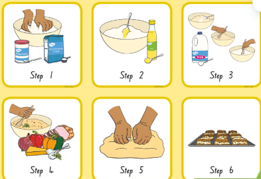
Crack eggs
Stir
Add flour
Bake
Eat
This supports sequencing, vocabulary, following steps, and participation in a shared activity, all while reducing the load of processing spoken instructions.
At the shops: Visual grocery lists
Children love being included in grocery shopping, and it is a great way to work towards a common goal together! Draw out a quick picture of each item you need to get at the grocery store (don’t worry, your drawings don’t have to be great!), and have your child help find those items.
Children can:
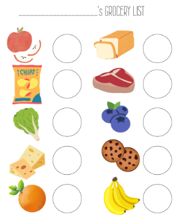
Help find items
Tick them off
Request something
Talk about categories
Make choices
A shopping trip becomes a meaningful language experience built around real-life participation.
During routines: Visual reminders
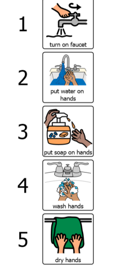
Simple visuals can support everyday routines such as:
Handwashing steps
Packing a school bag
Getting dressed
Bedtime routines
These supports can reduce the need for repeated verbal prompting and help children understand routines more clearly.
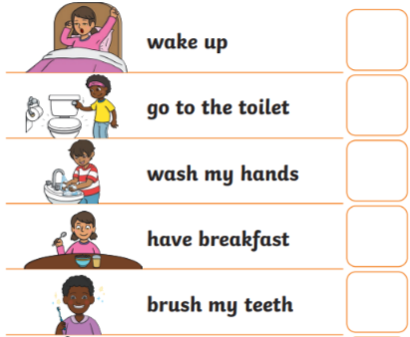
For many children, particularly autistic children, predictability and consistency can play an important role in supporting regulation, reducing uncertainty, and making daily life feel more manageable. When routines are clear and expectations are visually supported, children may have more capacity to engage, transition, and participate without needing to hold lots of spoken information in mind.
Visual schedules can be especially helpful because they make routines visible. Rather than relying on a child to remember a sequence of spoken instructions, a visual can show what is happening now, what comes next, and when the routine is finished.
Of course, routines are not about rigidity or doing things “perfectly.” They are about creating predictability, safety, and communication access in a way that supports the child’s individual needs.
Supporting choice-making
A simple visual choice board can support autonomy and communication:
Apple or banana?
Puzzle or blocks?
Bath or shower?
This gives children a way to express preferences and make decisions, while also reducing the pressure of relying only on spoken language.
A few tips for getting started
Visuals work best when they are:
- Simple: A visual doesn’t need to be fancy to be effective.
- Meaningful: Choose visuals that connect to your child’s real-life routines, interests, and needs. Does your child love Number Blocks? Try creating a morning routine visual schedule using the different number blocks!
- Paired with spoken language: Children benefit from hearing the words while seeing them. It is your job to model with the visuals, as we cannot just expect a child to know what to do with them!
- Part of everyday life: Visuals work best when they support genuine participation, not when they feel like “therapy homework.”
- Individualised: Some children prefer symbols, some like photos, some benefit from written words, and some may not need visuals at all. There is no one-size-fits-all approach.
Communication is about access
Visual supports are not about making children “perform” communication in a certain way. They are about making communication more accessible.
When children can see language, routines, choices, and expectations in a way that works for their brain, they often have more capacity to engage, participate, express themselves, and connect with the people around them.
Sometimes a simple picture, a checklist, a schedule, or a visual board can reduce the load of processing spoken language, and create more space for communication to happen in a way that feels safe, meaningful, and supported.
Because communication is not just about talking. It is about being understood, having access, and participating in your world!